
Quality in craftsmanship with training in proper tooling, equipment usage, and safe shop and field installation techniques is part of the sheet metal workers’ training and history in the Bay Area. Not only are projects formed with intention, but they are formed understanding the potential effects the construction has on airflow, moisture conveyance, and visual appeal.
ON DISPLAY

Shelf Display-Vintage Sheet Metal Tool Box
A sheet metal worker develops a relationship with tools, carrying them from project to project and using them to complete tasks as a craftsman. The toolbox on display was donated by a member whose father was a sheet metal worker starting in the 1950s.
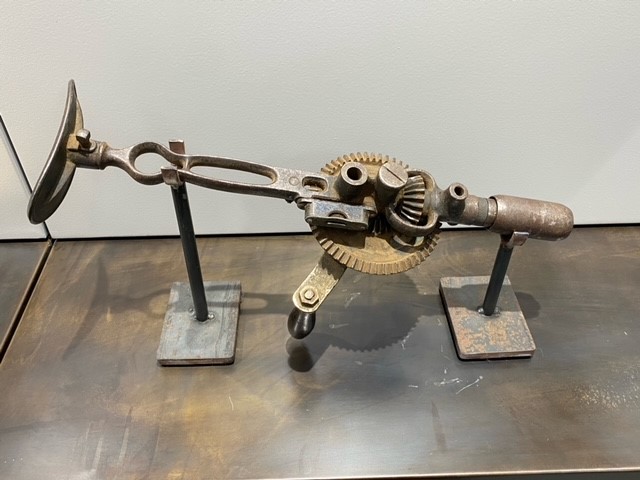
Shelf display -Hand Crank Drill
First developed in 1816, this drill was used to drive fasteners into metal by hand operation. The drills of modern times were not invented until 1917 when Black and Decker patented the first motorized drill.
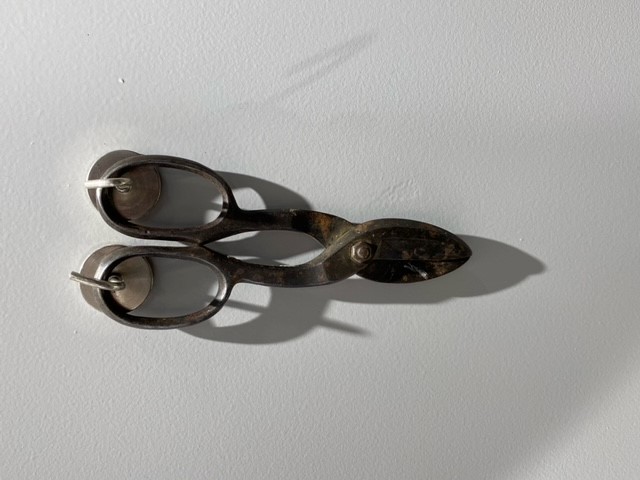
Middle Right Panel-Aviation Snips
Still used in the field today, aviation snips were invented in 1934 for cutting sheet metal on new planes which were made of aluminum.
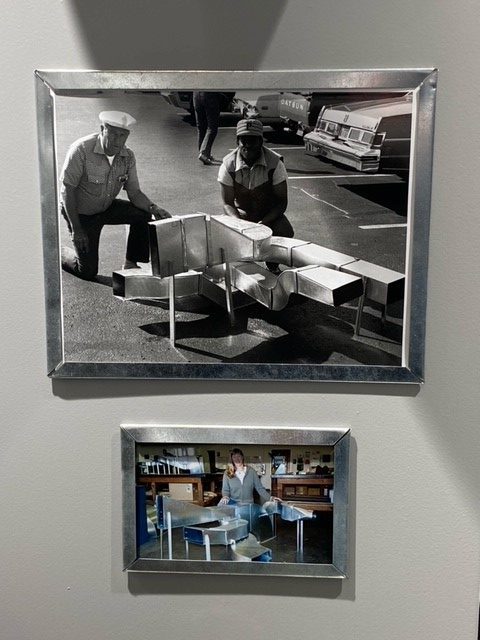
Middle Left Panel- Duct Design Projects
Attention to the design of duct systems has been consistently solidified through our industry training for decades. Minimizing an HVAC system’s impact on a building’s energy consumption is a concept which builds from drawings, to fabrication in the shop, and installation and testing, adjusting, and balancing (TAB) in the field. Seen throughout the displayed photos are students who have designed duct systems, completed shop layout, and fabricated and installed HVAC duct systems during their training.
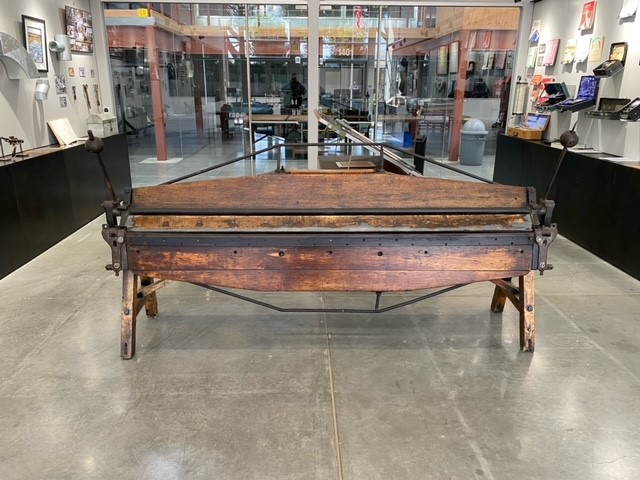
Center Aisle Entryway- Antique Sheet Metal Brake
The term “brake,” as used in modern sheet metal fabrication, comes from the Middle English verb “breken,” or “break,” which means “to bend, change direction, or deflect.”
The first “brake” as we know it was the cornice brake patented in 1882. It relied on a manually operated leaf that forced a clamped piece of sheet metal to be bent in a straight line. This machine is made of hand-worked, cast-iron components attached to finished oak wood panels. Over time, these have evolved into the machines we know today as leaf brakes, box and pan brakes, and folding machines seen throughout our training centers.
The first powered press brakes appeared just about 100 years ago, in the early 1920s, with flywheel-driven machines. These were followed by various versions of hydro-mechanical and hydraulic press brakes in the 1970s and electric press brakes in the 2000s.
Before the invention of the hand brake, if someone wanted to bend sheet metal, they’d attach an appropriately sized piece of sheet metal to a mold and pound the sheet metal into shape with stakes, hammers, and other forming tools.
Continue reading about the items on display in the Livermore history hallway