
In response to climate change concerns that surfaced in the late 20th century, society as a whole became increasingly concerned with the efficient use of energy by HVAC systems and the impact on the environment. It became apparent there was a growing need for individuals who specialized in testing, adjusting, and balancing (TAB) systems and HVAC service. A TAB and service technician verifies the intent of the system designer, by completing and documenting the following tasks:
- Assuring the balance and maintenance of the air and water distribution system,
- Adjusting the system as a whole to deliver design quantities,
- Completing electrical measurements,
- Verifying the performance of all equipment and automatic controls, and
- Measuring sound and vibration levels.
ON DISPLAY
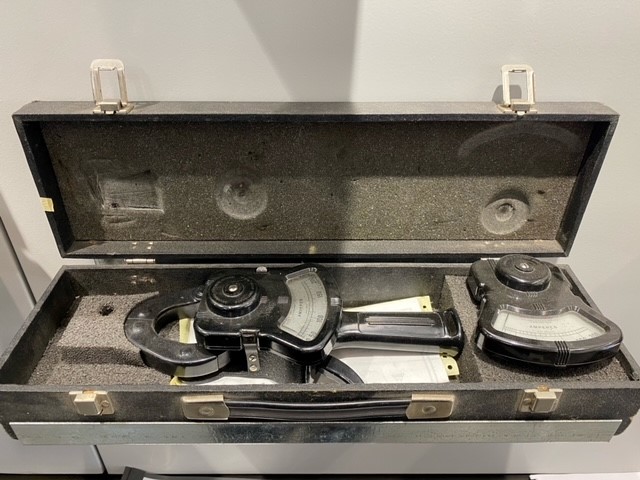
Right Bottom Panels- Antique Electrical Testing Instruments
Displayed are antique electrical reading devices used to measure volts, amps and ohms in an electrical circuit using an analogue scale. Current electrical testing equipment no longer includes analogue scales, but now includes digital readouts.
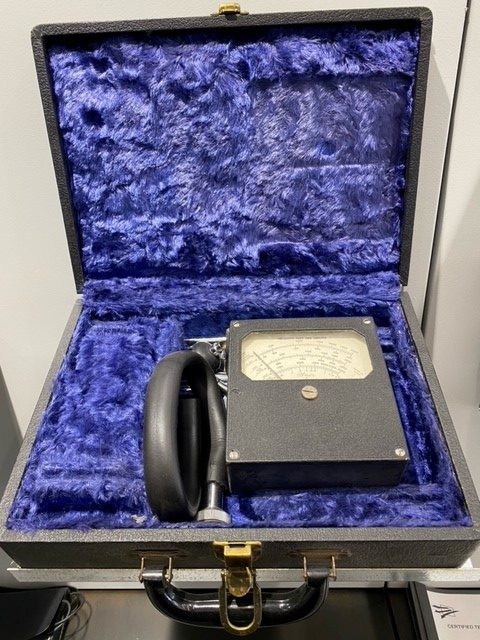
Middle Panel Bottom
This antique velometer was used to measure the speed of air in various applications. The velometer takes readings in feet per minute which can then be used to calculate cubic feet per minute (CFM), or volume of air, using math equations. Air flow measurements are essential to ensure the performance of a system meets the design criteria of a project. Modern devices, such as air data multimeters, take similar readings, but they read CFM without the need of additional calculations. Readings can also be stored, allowing for multiple readings to be recalled and adding efficiencies to project completion.
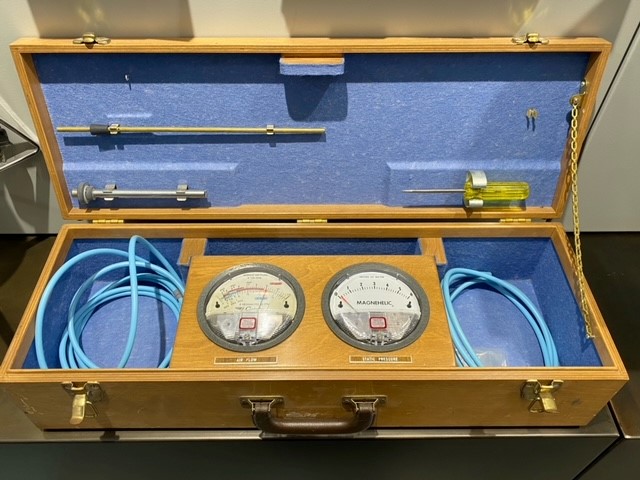
Left Shelf Display- Analogue Magnehelic Gauges
Magnehelic gauges are used to read pressure in a system or component. Often times, these gauges are used to identify pressure drop across components such as coils or filters. Modern gauges include analogue scales, but still perform the same function of reading system pressure in inches of water column.

Top Right Panel- Trane Ductulator
This Trane Ductulator was used to adjust aspect ratios of duct systems to accommodate for spatial limitations. Often used as a design tool, the training program incorporates the use of this instrument to this day. Our apprentices are supplied air duct calculators, which are used for the same purpose of designing and resizing duct systems.
The books displayed range from the early 1900s to 1946 and include hand-drawn details for fitting layout and pattern development. Shown in relation is a modern layout and fabrication fitting book which members have access to today in digital form.
Continue reading about the items on display in the Livermore history hallway